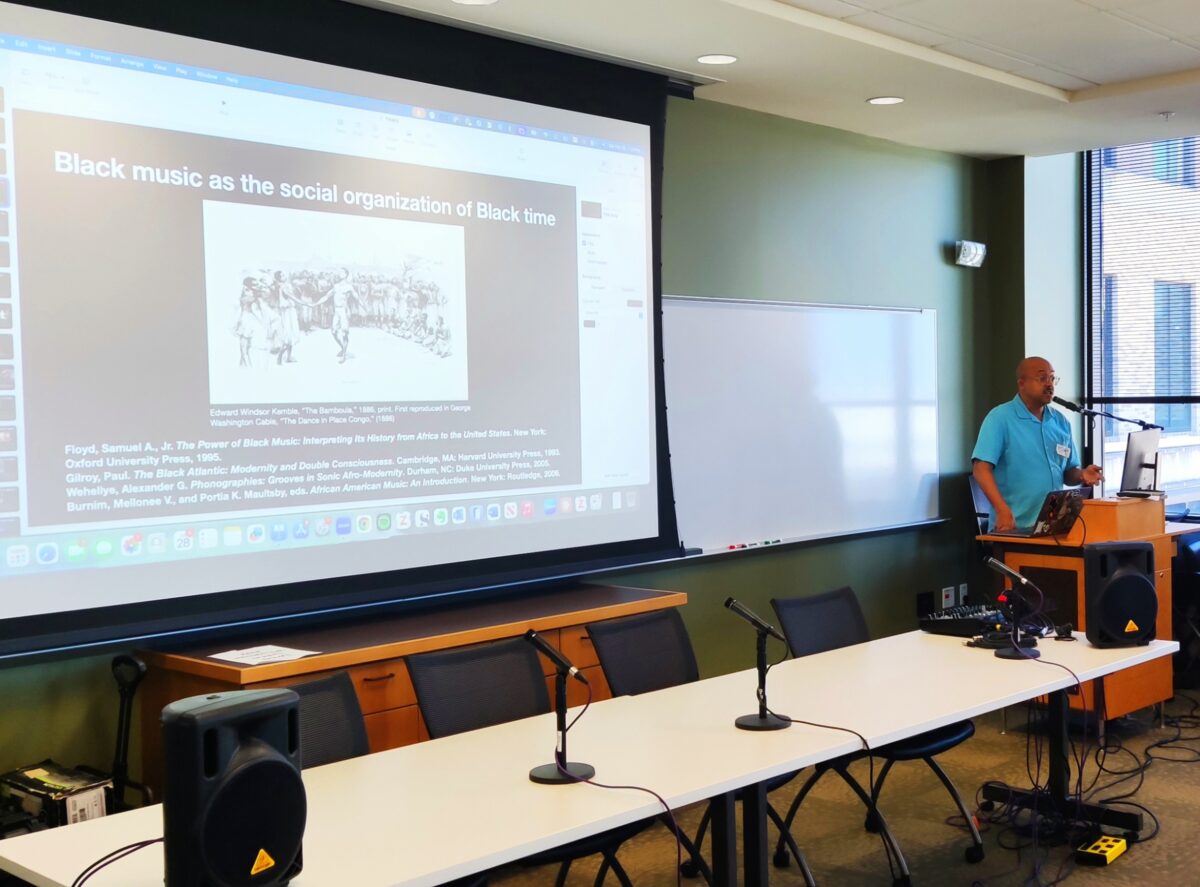


The third annual Afrofuturism conference saw an expansion in both the amount of participation and the support from donors, aligning with the 2026 theme of “Community.” Panels included public outreach, business, and health within the community, Latinx Futurist art, Afrofuturist music, various student projects related to Afrofuturism including video games, music, and poetry/spoken word, and literary research and discussions. The day was capped off with a new work of Afrofuturist dance and theatre conceived and choreographed by Everett Perry-Johnson. The event was sponsored by the TAMU College of Performance, Visualization, and Fine Arts, College of Arts and Sciences, the Creative Media Lab, and a new donor, H.E.B.
The opening panel was community focused discussions by Kia Dolby, creative design consultant, and Chet Sisk, community development and affirmative action consultant. The talks were separate, but both participated in a cross-talk, round table style discussion, introducing Afrofuturism as a model and inspiration for community growth and improvement.
The second speaker was artist Ernesto Cuevas, a Latinx Futurist artist who spoke to his background, influences, and work with and for the communities with which he has ties. His talk also displayed striking images of his works, as well as pictures of his childhood and current life in the San Antonio area, featuring his recent car art project, among many other incredibly impressive pieces.
Following lunch (supplied by H.E.B.), Dr, Tavia Nyong’o spoke on the state of Afrofuturist music in his talk, Reckonings and Reverberations: The Cultural Politics of Silencing Rock Music. His fascinating presentation drew upon his years of research at Yale University, bringing together his knowledge of historical development of Afrofuturist songs and sounds alongside his work with science fiction and the LGBTQ+ communities.
The fourth panel of the day featured three TAMU students who have all engaged with Afrofuturism on various levels in different ways. Kevin Johnson presented new poetry with music and visuals, setting the stage for how Afrofuturism is being employed and embraced as a means to artistically express oneself in today’s East Texas social climate. Justin Hopson updated the conference goers on the development of his Afrofuturist video game Duskfire Chronicles: Echoes of Tomorrow, that takes place in an alternate dimensional version of Houston (where Hopson grew up). Wrapping up the panel was an electronic music performance by composer/artist Ilana Rahim-Braden, playing two bespoke synthesizers made by Spanish instrument company Synamodec, specifically for use with TAMU Music Program students.
[Conference Video 05 – Justin Hopson Presentation]
The final panel focused on English scholars reflecting on Afrofuturist writing. Dr. Claire Carly-Miles presented new research on Octavia Butler’s various works, and Dr. Rebecca Hankins connected previous discussions (from last year’s conference) to African science fiction and fantasy in Kenya.
After the conference, the attendees relocated downstairs to the Black Box Theatre for the new Afrofuturist dance piece, Celestial Bodies, conceived of and choreographed by PFVA dance professor Everett Perry-Johnson. The performance featured two members of the production team, D’Mya Tabron and Jam Martinez, as well as several TAMU dance students.
The 2027 Afrofuturism Explored! conference is already being organized, and the guest artists and speakers, theme, and satellite activities will be announced soon! For more information, please visit the Afrofuturism Explored! Website.